One of the questions we hear most from people considering Telegram automation is simple: "Can a channel actually run on autopilot, or does someone always have to write the posts?"
The honest answer depends on the niche. For UGC-driven channels — classifieds, jobs, real estate — you need humans to moderate submissions. But for content channels where the topic is repeatable (recipes, quotes, daily facts, news digests, motivational posts), full autopilot is possible. We tested this on our own recipe channel, Bohrach, and the results changed how we think about content automation.
This is the story of how a recipe channel grew without a single manually written post — using InviteUp's AI content generation as the engine.
The experiment
Bohrach is a Ukrainian-language channel about simple, healthy daily recipes. The concept is straightforward: one new recipe per day, nothing complicated, nothing trendy — just food people actually cook on a Tuesday evening.
The challenge was just as straightforward. Running a recipe channel manually means daily work: pick a recipe, write the description, find or generate a photo, format it for Telegram, schedule the post. For one channel that's an hour a day. For five channels, it's a part-time job.
We wanted to find out: could InviteUp's autopilot maintain the channel without any human input after the initial setup? No daily check-ins, no manual writing, no manual photo selection. Just configuration once, then the channel runs.
How the autopilot was set up
InviteUp's content generation works through three layers:
Topic configuration. We set the channel topic — "simple healthy recipes for daily cooking" — plus tone preferences (friendly, practical, no fluff) and target audience description. This becomes the base prompt the AI uses for every generation.
Content plan. We chose a publishing schedule (one post per day at a specific time) and let the AI handle topic selection within the channel theme. The system rotates through different cuisines, meal types, and seasonal ingredients to avoid repetition.
Image generation. Each recipe gets a corresponding AI-generated photo of the dish. The visual matches the recipe content — pasta posts get pasta photos, soup posts get soup photos. This was the part that surprised us most: the visual quality is consistent enough that the channel doesn't feel like a content farm.
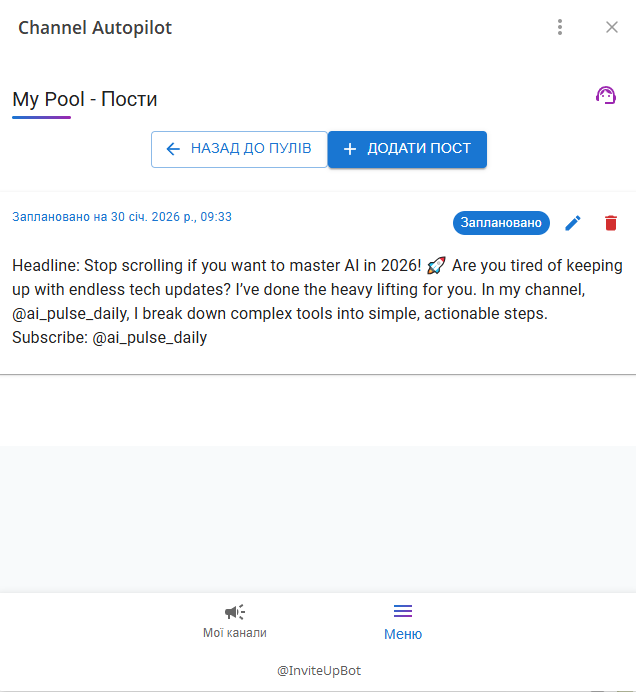
An example of a published post: a recipe with full description and matching food photo — generated entirely by AI, published without human review.
Results after running on autopilot
The numbers are modest but instructive — the point wasn't to build a viral channel, but to test whether the autopilot model actually works for a content channel.
339 organic subscribers — no paid promotion, no manual cross-posting
One recipe per day, published reliably for months
Zero failed posts — the system handles errors and retries
Zero hours of manual work after initial setup
The channel grew slowly because we didn't promote it. But the operational data was the real outcome: a Telegram channel with consistent daily content, professional-looking visuals, and zero human involvement after configuration.
Where this autopilot model works
Recipes are a good test case because the format is repeatable. The same logic applies to several other niches:
Daily quotes and aphorisms — InviteUp can rotate through philosophical traditions, modern thinkers, or topic-specific quotes
Historical facts and "this day in history" posts — date-aware content with consistent format
Motivational and productivity tips — daily advice with rotating themes
Curated news digests — AI summarizes from RSS or news APIs into channel-ready posts
Educational content — language learning, math facts, science explainers, vocabulary lessons
The common thread: content where the structure is consistent and the topic space is large enough that AI can generate relevant content for years without obvious repetition.
Where the autopilot model breaks down
Honest about limits — pure autopilot doesn't work everywhere. It struggles when:
The channel needs personal voice. Personal blogs, opinion channels, niche commentary — the audience subscribes for the author, not the topic. AI can't replicate that.
The content requires research or original reporting. News channels covering specific industries, investigative work, anything requiring source verification.
The community expects two-way interaction. Q&A channels, support communities, anything where the audience expects responses or recognition.
The format is UGC-driven. Classifieds, job boards, real estate listings, contest submissions — these need a different approach entirely, which is where Easy Post comes in.
Combining autopilot content with UGC
The most interesting setup we've seen is hybrid: autopilot for routine content + UGC for variety. A recipe channel running on InviteUp autopilot can also accept user submissions through Easy Post — readers submit their own family recipes, those go through a moderation queue, approved ones get published alongside the AI-generated content.
This combination solves the main weakness of pure autopilot (lack of personality) while keeping the operational efficiency. Most days the channel runs on AI; once a week or so, a real reader's recipe shows up. The audience gets variety, the admin keeps the workload near zero.
For channels considering this hybrid model, we've covered the UGC side in our guide on no-code form builders for Telegram and on treating a channel as a product.
What we learned
Three takeaways from running Bohrach on autopilot for a few months:
Setup matters more than ongoing work. The first few hours of configuration — defining the topic precisely, calibrating tone, picking visual style — determine 90% of the output quality. Once that's right, the channel just runs.
AI image generation is the unlock. Text-only autopilot existed before. The recent improvement in AI image generation is what makes content channels viable as autopilot. Photos that match the topic, look professional, and stay consistent across hundreds of posts.
Niche depth matters more than channel breadth. A focused recipe channel works because there are tens of thousands of recipes to draw from. A "general lifestyle" channel would struggle because the topic space is too vague for the AI to generate consistent content.
Should you try this?
If you have a channel idea that fits the autopilot pattern — repeatable structure, large topic space, no need for personal voice — InviteUp's autopilot is worth testing. The upfront cost is configuration time, not ongoing work. After a week of tweaking, the channel runs itself.
If you have channels with UGC needs (classifieds, jobs, listings, contests), pair the autopilot with a structured intake system. Easy Post handles the UGC layer through forms, moderation queues, and routing to Telegram channels or external systems. Together with InviteUp's content generation, you get a full content stack — AI-generated for routine output, structured intake for community contributions.
For channel automation specifically, check out InviteUp — they handle the content side better than any other Telegram-native tool we've used.